Beyond the PLC: Modernising Legacy Control Cabinets for Industry 4.0
- 5 hours ago
- 7 min read
Updated: 25 minutes ago

Key Takeaways
Modern PLCs remain valuable for machine control, but additional computing and networking infrastructure for Industry 4.0 workloads.
Retrofitting existing control cabinets can be a cost-effective alternative to a full "rip and replace" strategy, reducing downtime while preserving proven automation assets.
Edge computing, industrial HMIs, high-performance controllers, and Industrial Ethernet networking enable capabilities such as AI inspection, predictive maintenance, remote monitoring, and real-time analytics.
A modernized control cabinet can evolve from a standalone control system into an intelligent edge platform that supports connected, data-driven operations.
The future of industrial automation requires building on PLC success with the technologies that create smarter, more connected, and more resilient operations.
Have Traditional PLC Designs Reached Their Limit?
For decades, programmable logic controllers (PLCs) have been the foundation of industrial automation. Designed to continuously scan inputs, execute control programs, and update outputs, PLCs provide the deterministic, real-time control required for reliable machine operation. This predictable scan-cycle behaviour remains one of the key reasons PLCs continue to play a critical role across manufacturing, utilities, and infrastructure applications.
The challenge isn't that PLCs have failed. Rather, the demands placed on industrial systems have evolved significantly. Today's production environments require capabilities that extend well beyond traditional control functions, including:
AI-powered machine vision
Predictive maintenance analytics
Real-time data collection
Cloud connectivity
Advanced networking diagnostics
At the same time, Industry 4.0 initiatives are driving greater connectivity between machines, people, and enterprise systems. Manufacturers increasingly need access to operational data, remote monitoring, advanced analytics, and edge computing capabilities that bring processing power closer to machines and data sources.
While modern PLCs remain highly effective at machine control, they were not originally designed to manage these data-intensive workloads alone. As a result, many organisations are looking for ways to extend the capabilities of existing control systems without replacing proven PLC infrastructure.
Fortunately, achieving Industry 4.0 objectives does not require a complete system redesign. By retrofitting legacy control cabinets with technologies such as edge computing, advanced networking, industrial HMIs, and high-performance control platforms, engineers can transform traditional PLC cabinets into intelligent edge centres while preserving existing automation investments.
Exploring Retrofitting Over ‘Rip and Replace’
For many facilities, replacing an entire automation system is costly, disruptive, and difficult to justify when existing PLCs continue to perform their primary control functions reliably. Instead, manufacturers are increasingly adopting a retrofit approach that supplements legacy cabinets with modern technologies.
Compared with a full system replacement, retrofit projects typically offer lower capital expenditure, faster deployment, reduced downtime, and a more manageable path to digital transformation. Rather than viewing the PLC as a constraint, modern retrofit projects position it as the foundation of a broader intelligent architecture.
Adding Edge Computing and AI Without Replacing PLC
By integrating an industrial edge computer into the control cabinet, manufacturers can run AI inference, host local SCADA platforms such as Ignition or Wonderware, collect and store operational data, and support real-time decision making at the machine level. This approach reduces latency, improves responsiveness, and enables Industry 4.0 capabilities while allowing the PLC to continue performing its core control functions.
Axiomtek Edge Systems

With over 35 years of success, Axiomtek is a trusted leader in embedded systems, edge computing, and IoT. Their portfolio of high-performance edge solutions is purpose-built for innovation and enable automated defect detection, reduce human error, and support Industry 4.0 goals through scalable, rugged, and customizable hardware in industrial applications like metal pressing[JH1] .
The ICO150 features fanless DIN-rail embedded systems with Intel Atom® x7433RE, supporting wide temperature ranges, multiple I/O including 4 COM, 4 USB, 2 2.5GbE LAN, HDMI, and DIO. Specifically engineered for industrial applications, the ICO150 leverages power protection, expansion options, and software support via AXView.
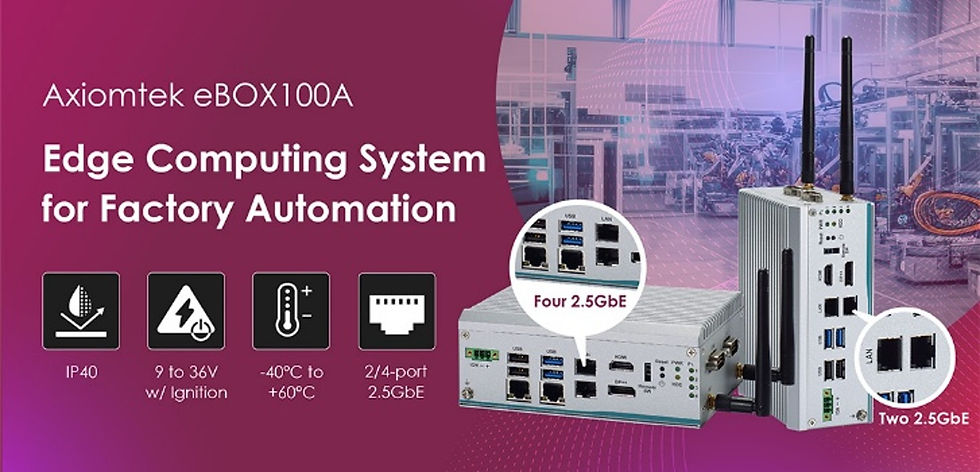
Additionally, the eBOX100A is another Axiomtek fanless embedded system solution specifically designed for edge computing and IoT applications. Supporting Intel® Processor N97 (codename: Alder Lake-N), the eBOX100A offers options for 2 or 4 2.5GbE LAN, HDMI, DisplayPort++, USB, and COM ports. It operates from -40°C to 60°C, supports DDR5 memory up to 16GB, and includes expansion slots, storage, and power protections.
[JH1]Case study headline from product table addresses AI in the food and beverage industry. However, the link takes me to a case study about metal pressing. Not sure if this needs to be corrected.
Upgrading Operator Visibility with Industrial HMIs
Modern Human-Machine Interfaces (HMIs) bridge the gap between operators and increasingly complex automation systems by providing real-time visibility into machine status, process data, alarms, and performance metrics.
Purpose-built for mounting on the front door of PLC cabinets and machine enclosures, industrial HMIs provide a centralized interface for monitoring operations and making informed decisions on the plant floor. By improving data visualization and simplifying operator workflows, HMIs can help reduce errors, improve productivity, and support more consistent production outcomes.
Cincoze CV-200 Series

A global leader in rugged embedded computing and Edge AI solutions, Cincoze is a global has designed the CV-200 Series specifically for modern industrial HMI applications. Featuring a slim-bezel design and Full HD display options ranging from 10" to 21.5", the series combines a compact footprint with the durability required for industrial environments.
Powered by Cincoze's Convertible Display System (CDS) technology, the CV-200 can be configured as either an industrial panel PC or touch monitor, providing flexibility for a wide range of cabinet modernization projects. Its front-panel IP66 rating, projected capacitive (P-Cap) touchscreen, anti-glare coating, and robust one-piece construction make it well suited for applications exposed to dust, humidity, and bright ambient lighting.
In an automotive assembly plant, the Cincoze industrial panel PC solutions have been deployed as a production-line HMI, providing operators with real-time work instructions, torque verification data, and process monitoring. The solution improved quality control, traceability, and operator accuracy while enabling centralized production monitoring.
Boosting PLC Performance
Tasks such as robotics, precision motion control, high-speed inspection, and real-time data acquisition often require deterministic performance at a level that exceeds standard PLC capabilities. Rather than replacing the PLC, many organisations choose to supplement existing control systems with a high-performance controller that can manage specialized workloads while the PLC continues handling core machine control.
Emerson/NI CompactRIO
CompactRIO (cRIO) from NI is a rugged, modular control platform designed for advanced industrial automation applications. Combining a real-time processor, FPGA technology, and customizable I/O, CompactRIO enables high-speed processing and precise control in environments where performance and reliability are critical.
In applications such as robotic production cells, CompactRIO has been used to coordinate complex automation processes requiring fast response times and real-time decision-making. Similarly, in steel rolling mills, manufacturers have leveraged CompactRIO to optimize existing PLC-based automation systems and improve process performance. These examples demonstrate how advanced control platforms can extend the capabilities of established automation architectures without requiring a complete redesign.
Building an Industry 4.0 Network Backbone
Connectivty is the foundation of any Industry 4.0 initiative. As control cabinets evolve
beyond basic machine control to incorporate HMIs, edge computers, high-speed controllers, and cloud-connected systems, the network infrastructure must be capable of reliably moving data between devices while maintaining visibility, performance, and uptime.
Industrial Ethernet switches provide the communication backbone that connects PLCs, operator interfaces, embedded computers, and control systems into a unified architecture. They also enable the operational data required for real-time monitoring, predictive maintenance, remote diagnostics, and intelligent decision-making.
Oring Industrial Ethernet Switches

For over 20 years, ORing has specialised in industrial innovation. Their solutions have been widely adopted in surveillance, rail transport, and factory automation markets. Designed for demanding industrial environments, Oring's Ethernet switches help manufacturers build reliable and scalable networks that support both today's operational requirements and future Industry 4.0 initiatives.
For straightforward control cabinet deployments, ORing’s IES-3082GP-LA and IGS-9080-LA-PN provide plug-and-play networking between key automation components, including:
PLCs
HMIs and touch panels
Embedded edge computers
Industrial controllers
Ideal for point-to-point connectivity where simplicity, reliability, and ease of deployment are prioritised, these switch solutions don’t require software configuration or specialist networking expertise.
Modern Power Infrastructure Matters
While legacy PLC cabinets often had relatively modest power requirements, modern Industry 4.0 architectures demand reliable, efficient power distribution to support a growing number of connected devices.
RECOM RACPRO1 Series

Designed for industrial automation applications, the RECOM RACPRO1 DIN rail power supply series delivers high-efficiency power conversion in a compact form factor. Its space-saving design, high reliability, and robust thermal performance make it well suited for modern control cabinets where panel space and uptime are critical.
Key Benefits
DIN rail-mounted design for easy cabinet integration
High-efficiency power conversion to reduce energy loss and heat generation
Reliable operation in demanding industrial environments
Compact footprint that maximizes available cabinet space
Supports expanded architectures incorporating edge computing, networking, and HMI technologies
Future-Proofing Industrial Infrastructure with Solutions Available at Braemac
As manufacturers across Australia and New Zealand accelerate their Industry 4.0 initiatives, the challenge is not whether to modernise, but how to do so cost-effectively while protecting existing automation investments. For many facilities, retrofitting legacy control cabinets with edge computing, advanced networking, modern HMIs, high-performance control platforms, and reliable power infrastructure offers a practical path forward.
Rather than replacing proven PLC-based systems, manufacturers can extend their capabilities to support real-time analytics, AI-driven inspection, predictive maintenance, remote monitoring, and cloud connectivity. The result is a smarter, more connected industrial environment that delivers greater operational visibility, improved reliability, and a scalable foundation for future digital transformation.
At Braemac, we help engineering teams identify the technologies and architectures needed to modernise industrial control systems with confidence. Through our portfolio of industry-leading suppliers, including Axiomtek, Cincoze, Emerson/NI, Oring, and RECOM, we provide the building blocks required to transform traditional control cabinets into intelligent Industry 4.0 edge platforms. Our technical specialists work closely with customers to balance performance, reliability, power requirements, thermal constraints, and long-term scalability, helping ensure each solution is optimised for its application today and ready for the demands of tomorrow.
Contact info@Braemac.com to learn more.
Industrial PLC Frequently Frequently Asked Questions
Can I add AI capabilities to an existing PLC cabinet?
Yes. Edge computers can process AI workloads while the PLC continues handling real-time machine control.
What is industrial edge computing?
Industrial edge computing processes operational data locally instead of sending everything to the cloud, enabling faster insights and reduced latency.
Do I need to replace my PLC for Industry 4.0?
No. Most facilities can modernise cabinets by adding edge computing, networking, HMI, and analytics platforms alongside existing PLC infrastructure.
What networking protocols are common in Industry 4.0 systems?
PROFINET, EtherNet/IP, and Modbus TCP remain among the most widely adopted industrial networking protocols.
What are the benefits of predictive maintenance?
Predictive maintenance can reduce unplanned downtime, improve asset utilisation, and lower maintenance costs through condition-based monitoring.