
Beyond the Basics of Advanced Autonomous Design
Updated: Jun 25

Key Takeaways
Advanced autonomy depends on specialized hardware architectures that enable real-time AI inference, sensor fusion, and deterministic decision-making at the edge, which requires system-level design approach
Next-gen drone capabilities depend on three core systems that collectively define performance:
Edge processing & Control
Navigation, localization, & perception
Communications & networking
Designing for real-world environments requires resilient architectures that can overcome thermal constraints, GNSS degradation, RF interference, and connectivity disruptions.
Braemac is a solutions provider for drone innovation, offering a wide portfolio of cutting-edge components purpose-built to support advanced autonomous systems capabilities.
Addressing the Growing Demand for Autonomy
The rapid adoption of autonomous systems is driving unprecedented growth across unmanned aerial vehicle (UAV), drone, and autonomous mobile robot (AMR) markets. As organizations deploy these platforms for surveillance, logistics, agriculture, infrastructure monitoring, and defense applications, onboard systems are being tasked with processing larger volumes of sensor data, supporting multiple wireless links, enabling advanced navigation, and making real-time decisions at the edge.
To meet evolving mission requirements, developers are increasingly adopting modular architectures that allow sensors, radios, GNSS receivers, AI accelerators, and compute resources to be added or reconfigured without redesigning the entire platform. While this approach improves flexibility, scalability, and platform longevity, it also introduces new challenges in RF system design. Engineers must balance competing requirements including size, weight, power, and cost (SWaP-C), low-latency communications, reliable connectivity, spectrum awareness, and resilience against interference, spoofing, and jamming.
Core Systems of Next-Gen Autonomous Architecture
1. Memory and Edge Processing
Navigating Advanced AI Capabilities Amidst Hardware Limitations
Embedded processing architectures have evolved beyond traditional MCU-based designs toward advanced heterogeneous computing platforms that synergize the benefits of MCUs, DSPs, NPUs, GPUs, and dedicated AI accelerators. Supporting advanced workloads such as vision transformers, real-time object classification, sensor fusion, and safety-critical decision-making requires significantly greater computational performance than legacy architectures can provide.
However, system developers face a fundamental design challenge known as the "memory wall," where transferring data between the processor and external memory becomes a major source of latency, power consumption, and heat generation. Engineers are trapped between needing high-end AI capabilities and operating within strict, fanless SWaP-C constraints.
To overcome these limitations, modern drones and autonomous vehicles are increasingly relying on edge computing as a solution. Cameras, LiDAR, radar, infrared sensors, GNSS receivers, and inertial measurement units continuously generate large volumes of data that must be analyzed in real-time. By integrating Ai and decision-making at the edge, autonomous systems can reduce latency, improve reliability, and maintain operation even in environments with limited connectivity.
Design Techniques for Next-Gen Computing
Fault-Tolerant Control Architectures
To operate safely even when components degrade, sensors fail, or environmental conditions change unexpectedly, fault-tolerant control architectures improve system resilience by detecting issues early and adapting vehicle behavior to maintain stability and mission continuity. As the decision-making layer of the vehicle, onboard compute enables adaptive control systems, health monitoring and predictive maintenance, and failover logic that helps ensure mission continuity and safe operation.
Leveraging Purpose-Built Compute Platforms
Ensuring optimal processing architecture is one of the most important design decisions for autonomous systems. As a global distributor with a unique value-added approach, Braemac deeply understands the requirements of specialized compute platforms that combine high-performance processing with hardware acceleration to overcome memory, thermal, and power limitations.
Our line card features best-in-class compute solutions from premier suppliers, including:
Altera: High-performance FPGAs and SoC platforms help address growing compute density requirements by enabling hardware-accelerated AI pipelines, sensor processing, and custom workloads at the edge.
Programmable logic allows developers to optimize data movement and parallel processing, reducing memory bottlenecks while delivering exceptional throughput-per-watt performance.
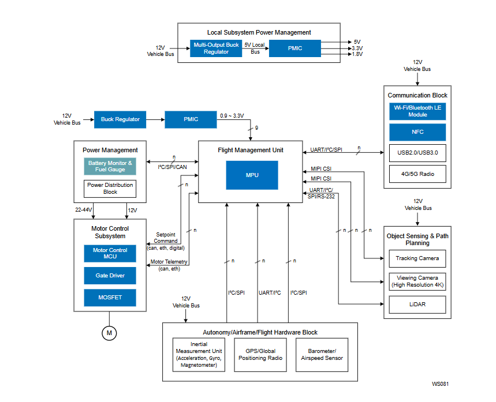
Renesas: The R-Car SoC family and RZ/V Series MPUs, featuring proprietary DRP-AI acceleration, provide a powerful option for thermally constrained autonomous platforms. These devices support advanced vision AI, machine learning inference, and real-time control without requiring active cooling, enabling compact drones, AMRs, and other edge AI systems to maintain high performance while minimizing power consumption.
2. Navigation and Localization
Ensuring Resilient Positioning in Real-World Environments
Autonomous systems are only as effective as their ability to understand where they are and how they move through an environment. Relying solely on consumer-grade GPS or pre-programmed maps is a recipe for disaster in modern UAVs and drones operating in dynamic, unstructured surroundings.
GNSS signals can be obstructed by urban canyons, degraded by warehouse infrastructure, or intentionally disrupted through jamming and spoofing. As autonomy levels increase, achieving reliable positioning requires resilient navigation architectures capable of maintaining accuracy even when primary positioning sources are unavailable.
Design Techniques for Comprehensive Navigation Architecture
Make Multi-Sensor Functionality the New Baseline
To overcome limitations of standalone GNSS, autonomous platforms increasingly rely on multi-sensor fusion. Rather than depending on a single source of data, today’s navigations systems combine intelligence from GNSS receivers, inertial measurement units (IMUs), cameras, LiDAR, radar, and barometric sensors to build more accurate, robust positioning.
For applications requiring even greater precision, Real-Time Kinematic (RTK) corrections can enhance positioning accuracy from meters to centimeters. This level of precision enables advanced capabilities such as autonomous landing, coordination, automated return-to-base functionality, and operation in densely populated or infrastructure-rich environments.
Design for Environmental Awareness at the Edge
Environmental awareness architectures combine localization data with perception systems to create a comprehensive model of the operating environment.
Key capabilities include:
Dense environmental mapping for navigation and mission planning
Real-time terrain and surface classification
Dynamic object tracking and threat detection
Low-latency obstacle detection and avoidance pipelines
Semantic scene understanding for autonomous decision-making
Effective localization begins with understanding the operating environment. Selecting positioning technologies designed for real-world challenges, such as heavy foliage, multipath interference, and GNSS-obstructed indoor spaces, enables autonomous systems to maintain reliable location intelligence when conventional positioning methods begin to fail.
Septentrio: Tackles signal vulnerability head-on with their ultra-compact mosaic-G5 and mosaic-X5 GNSS receiver modules. Packing premium AIM+ anti-jamming and anti-spoofing technology into a tiny, low-SWaP footprint, Septentrio ensures that UAVs and robotic platforms maintain resilient centimeter-level RTK positioning even in highly contested or jammed environments.

Calian: Provides the crucial physical anchor to the navigation stack with their high-precision, multi-band GNSS antennas. Engineered to mitigate multi-path errors and pick up weak signals in challenging environments, Calian’s antenna solutions complement advanced receivers to provide an unshakeable, high-fidelity data foundation for sensor fusion algorithms.
3. Communication and Networking
Why a Cutting-Edge Communication Stack Matters
From coordinated groups to fleets of AMRs, maintaining resilient communications and networking is crucial to autonomous system functionality. Communication failures can have immediate operational and safety consequences. For collaborative autonomous systems, a dropped packet is more than a network issue. It can result in mission disruption, navigation errors, or unsafe vehicle behavior.
As autonomy scales, communication architectures must deliver deterministic, low-latency performance while maintaining reliability in increasingly congested RF environments. Engineers face the challenge of designing communication systems that can withstand electromagnetic interference (EMI) from industrial equipment, cross-talk from neighboring vehicles, and dynamic spectrum conditions without sacrificing performance, power efficiency, or range.
Design Techniques for Securing Autonomous Communications
Multi-Band and Multi-Radio Functionality
Modern autonomous platforms rely on multiple communication technologies operating simultaneously to support command and control, telemetry, sensor data exchange, vehicle-to-vehicle coordination, and cloud connectivity. Rather than depending on a single wireless protocol, next-generation communication architectures increasingly employ layered, multi-radio approaches designed to optimize performance across diverse operating environments.
Different mission requirements often demand different communication technologies. Sub-GHz radios provide long-range, low-power connectivity, while L-, S-, and C-band systems support higher throughput and mission-critical communications. Cellular, Wi-Fi, satellite, and mesh networking technologies further expand operational flexibility.
By combining multiple radios within a single platform, engineers can create redundant communication pathways that improve reliability and allow autonomous systems to maintain connectivity even when individual links become unavailable.
Interference Mitigation
Reliable communication depends on more than transmission power alone. Autonomous platforms must be capable of identifying interference sources and adapting accordingly. Advanced communication systems increasingly incorporate channel-hopping techniques, adaptive modulation, beamforming, and intelligent spectrum management to maintain link quality in crowded RF environments.
Connected communication security is a paramount design consideration. Communication links represent one of the most common attack surfaces for autonomous systems and must be designed to withstand both cyber and RF-based threats.

Skyworks: Eliminates the risk of wireless dropouts with their highly integrated RF Front-End Modules (FEMs), power amplifiers, and low-noise amplifiers. By optimizing the physical RF paths for high efficiency and robust signal isolation, Skyworks solutions ensure that peer-to-peer mesh networks and high-bandwidth wireless links maintain a clean, ultra-reliable connection, keeping autonomous fleets perfectly synchronized without saturating the power budget.
How Braemac Supports Drone Systems Integrations
At Braemac, we help engineering teams accelerate autonomous system development through access to industry-leading solutions. Our technical experts work closely with customers to identify the optimal architecture for their application, helping balance performance, power efficiency, thermal constraints, reliability, and scalability throughout the design cycle.
Our comprehensive portfolio leverages the building blocks required to transform autonomous concepts into deployable systems. Solutions from suppliers such as Altera, Renesas, Septentrio, Calian, and Skyworks enable designers to address some of the most difficult challenges in autonomy, including real-time AI processing, resilient localization, anti-jamming navigation, and ultra-reliable wireless connectivity.
Ready to accelerate your autonomous design? Contact info@Braemac.com
Drone Design Frequently Asked Questions
Why are traditional MCU-based architectures no longer sufficient for advanced autonomous systems?
Modern autonomous platforms must simultaneously process AI inference, sensor fusion, computer vision, navigation, and real-time control functions. These workloads often exceed the capabilities of traditional MCU-only designs, driving the adoption of heterogeneous computing architectures that combine MCUs, GPUs, NPUs, DSPs, FPGAs, and dedicated AI accelerators to deliver higher performance within SWaP-C constraints.
Why do autonomous vehicles rely on sensor fusion instead of GNSS alone?
GNSS provides valuable positioning data, but signals can be degraded by dense foliage, urban canyons, warehouse infrastructure, weather conditions, or intentional jamming and spoofing. By combining GNSS with cameras, LiDAR, radar, IMUs, and barometric sensors, autonomous systems can maintain accurate localization and continue operating safely when individual sensors become unreliable.
What is the difference between SLAM and neural-SLAM?
Traditional Simultaneous Localization and Mapping (SLAM) uses sensor data to build maps and determine vehicle position within an environment. Neural-SLAM enhances this approach by incorporating AI models that provide semantic understanding of the surroundings, enabling autonomous systems to recognize objects, classify terrain, and make more intelligent navigation decisions.
Why are multi-radio communication architectures becoming more common in autonomous systems?
No single wireless technology can satisfy every operational requirement. Autonomous platforms often combine Sub-GHz, cellular, Wi-Fi, satellite, and mesh networking technologies to balance range, bandwidth, latency, and reliability. Multi-radio architectures provide communication redundancy and allow systems to maintain connectivity across diverse operating environments.
What role do software-defined radios (SDRs) play in autonomous vehicle communications?
Software-defined radios allow autonomous platforms to dynamically adapt operating frequencies, protocols, and modulation schemes based on mission requirements and spectrum conditions. This flexibility improves spectrum efficiency, helps mitigate interference, and enables operation across different geographic regions and regulatory environments.
What are the most important design considerations for building reliable autonomous systems?
Successful autonomous designs require a system-level approach that balances edge computing performance, localization accuracy, communication resilience, security, power efficiency, thermal management, and environmental awareness. Engineers who co-design hardware, firmware, AI, and connectivity architectures from the beginning are better positioned to deliver reliable autonomous operation in real-world conditions.


